

Over diagnosis
I was sent to multiple educational psychologists as a child and I have a lot of feelings about it.

My parents seemed to notice there was something different about me fairly early in life. From nursery or reception age, perhaps? I was outgoing, articulate, had an impressive memory and an endearing imagination. I told complicated, lovely stories and basically came with all the hallmarks of being a bright child. So it came as something of a surprise that when I got to school, it seemed that I was not bright.
My first primary school was an all girls fee paying behemoth running from age four to eighteen, in South West London and I’m sure a very different place now than it was then. My main memories are of getting everything wrong. We were given scissors and told to cut around the outline of a chicken. Everyone else did it with ease. I cut the chicken’s beak off. I asked for another one, so I could try again, and for whatever reason, the offer was declined. Everyone else put their chicken on a sort of split pin and lollipop stick arrangement which meant it could be hinged forward, like it was pecking grain from the ground. My chicken had no beak, so couldn’t peck. I was fairly sure that meant it would starve.
Similar stories abounded - doing a project on Seurat where we were supposed to paint in tiny dots, becoming overwhelmed by irritation at how long the process took so painting without dots and being told mine was the only picture which couldn’t go on the wall. I’m aware that children are being bombed every day and these daily or weekly indignities are, in the grand scheme of things, a nothing. But they added up to something, a sense that I was different and not in a good way. After eighteen months at this school, and multiple meetings with my parents, the school told us we weren’t for them, and that I might be better off at another school (unthinkable in a post VAT on school fees world where they’re clawing to keep every single child).
My parents were the first of their friends to have children and whether through love, naivety or that lovely precious first born syndrome we all enjoy, remained convinced that I was clever, but that something was standing in the way. And thus began the assessments. I was five.
There were Harley Street waiting rooms which proceeded offices with large wooden desks and thick carpets where they asked me if I could name any oceans (I couldn’t, and I knew this was going to matter so I explained that it wasn’t that I was stupid, it was that no-one had ever told me their names). There was IQ testing with a nice woman trying very hard to ‘make it fun’. In mid-primary school, after a move to a different school hadn’t cured me, I started seeing a kindly woman in Surrey, named Sharon. I was driven to her house multiple times and did endless verbal reasoning, non verbal reasoning, spacial awareness assessments, interviews and writing exercises. I remain fond of Sharon because let me watch Friends and eat a white chocolate Magnum while she debriefed my mother about my progress and my diagnosis. At the time I was initially diagnosed with dyslexia and dyspraxia. I have since had that diagnosis revisited as ADHD, but it was the 1990s, I wasn’t massively hyperactive and ADHD was pretty much for boys.
It was explained to me that my ‘brain goes too fast for my hands’ which was impacting my handwriting and spelling, and that the best treatment was to learn to touch type. So I was taken to a dark townhouse in Clapham where a woman named Alison taught touch typing to educationally subnormal children. It was a large Victorian place, her living room had been turned into a classroom with banks of enormous computers, connected in a sort of umbilical manner to keyboards which, apparently, were going to save us from our fate. Everyone else there was a boy, and everyone else there was also the middle class child of a middle class parent who couldn’t work out why their child wasn’t achieving as expected.
Once I’d learned to touch type - training which would be rendered completely risable when everyone else got MSN messenger in the 2010s and learned to type at warp speed - I was given a laptop. The same one Carrie Bradshaw has in the early seasons of SATC. The idea was that I’d use the Carrie Bradshaw laptop in all my lessons at school (‘I couldn’t help but wonder… has my mum put a NutriGrain in my lunchbox?’) which absolutely didn’t work because you can’t do a worksheet on a laptop and primary school is wall to wall worksheets. When I was given the laptop I remember Alison the dyslexic friendly typing teacher saying ‘this will make you a bit different from other people, and will mean you’ve got to do a bit of extra admin’, which is possibly the least helpful thing anyone has ever said to me, I’m still raging about it. I was nine, I didn’t want to be different, I didn’t want to have to do extra admin. I also had raging undiagnosed ADHD and was neurologically incapable of doing the ‘extra admin’ (remembering to charge the laptop, which eventually went into a case under my bed and remained there until I used it write my first novel.**
Being sent to see odd adults who were supposed to help me but made me feel worse about myself became a feature of my life. I had to have ‘learning support’ lessons, where I was taken away from a more fun lesson and given extra tutoring, which was a bit made because I was reading Charlotte Bronte in my down time. In the eleven years of these extra lessons I had one singular nice learning support teacher, a woman called Jenny Frost. She once took me for a learning support lesson as scheduled, during the end of term Christmas party. I sat in the empty art room, where the lessons took place, and sobbed about how unfair it was, how I didn’t want to be special or different, how I didn’t need any help and I would much rather just be a bit shit and get to carry on with my life like everyone else got to. She scrunched up a hand towel to make it softer before I blew my nose on it and agreed that it was shit, and sad, and unfair. And then at the end of term she left and I got another woman wearing a black and floral tunic dress and a ‘fun’ necklace.
I hoped secondary school might put paid to the learning support lessons, but no, once again, being extracted from more enjoyable lessons like music or art (or even worse, lunch break) to sit in a class room with a woman named Sue or Yvonne and look at word pairs was a feature of my life. The Learning Support classroom at my secondary school had pictures of famous dyslexics on the wall, as if that was going to make us feel better, as if seeing a black and white photo of Zoe Wannamaker smiling and saying ‘I’ve got Dyslexia too!’ would bring some deep inner peace to the indignity of the whole thing. The day Daniel Radcliffe acknowledged his dyspraxia must have been fucking Mardi Gras for these people.
When I was fifteen I was sorted into the top set for English, the first time this had ever happened to me for any subject. Obviously I should have been in the top set for English, I have been a fucking brilliant writer and an even better analyst of other peoples’ work since I could read. Ms Bartlett, the learning support teacher, made investigations as to whether this was a good idea. I told her that literature wasn’t about letter sounds, and then I stopped going to her lessons. I watched The O.C on my laptop in the locker rooms for our sessions every week for a year. I don’t know what she did. Went for a fag? Ordered more ‘inspiring’ photographs of national treasures with learning difficulties?
Finally, after ten years of assessment and guess work about what was wrong with me, I decided to just embraced denial. Nothing wrong, everyone fuck off and leave me alone.
I have no doubt that everyone (apart from Mrs Bartlett, who was a ghastly woman) was doing their best to protect me from feeling like I was being watched or assessed or found wanting, but I was clever, they all kept telling me I was clever, so they should probably have clocked that if you put a child into test conditions for assessments on the reg, they’re going to clock that something’s wrong with them, and if they don’t clock that then they’re not clever and you’re wasting everyone’s time. Maybe there’s no way of avoiding that feeling, though? And perhaps the real issue here isn’t all the intervention, but the fact that I didn’t really need it. Perhaps if I had needed it, I’d have been grateful for it?
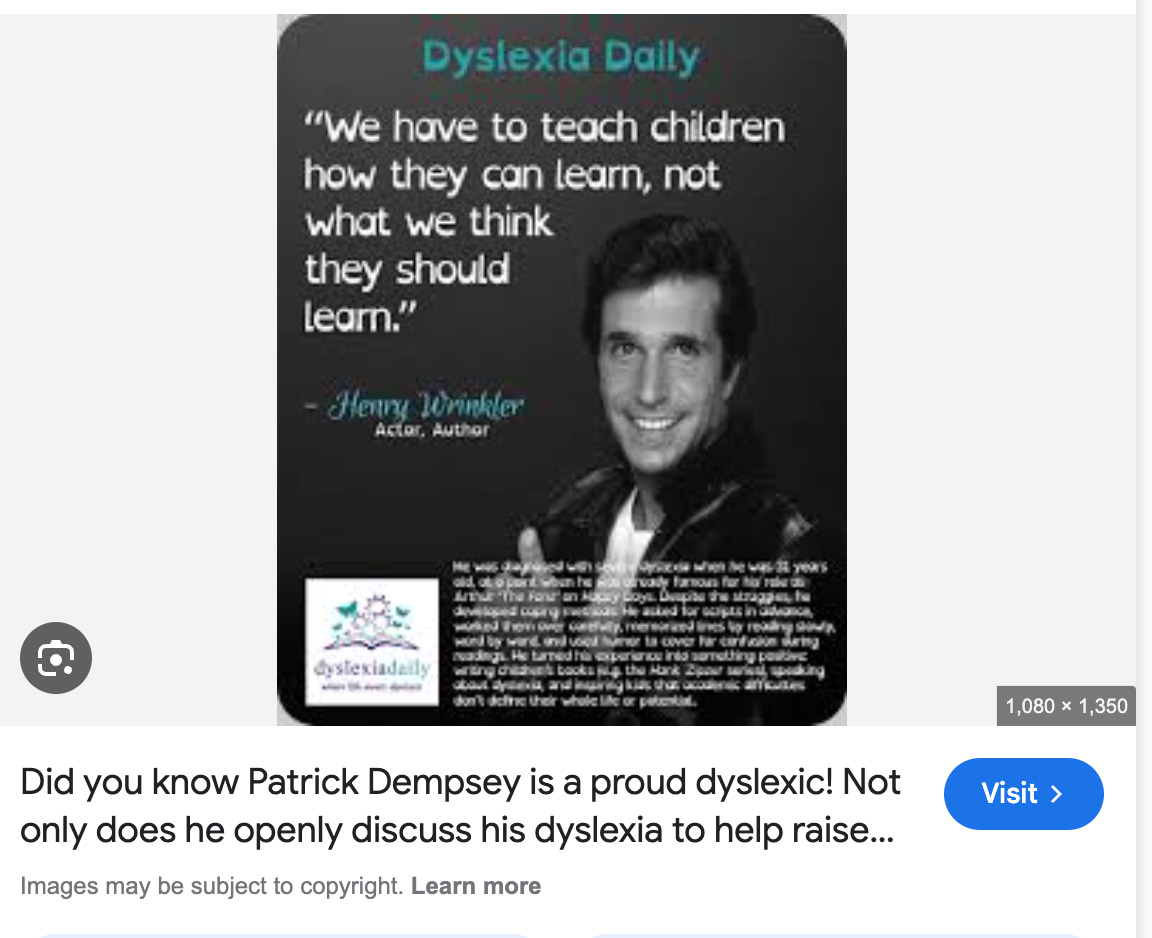
DID YOU KNOW THAT PATRICK DEMPSEY IS A PROUD DYSLEXIC?
I’m also keenly aware that this was a very expensive series of interventions designed to make my life happier and better and it’s a bit churlish that I’ve been left damaged by them. But the truth is, I have spent my whole adult life looking for people to tell me that I’m okay. In my younger years it was other teenagers, buying Juicy Coture tracksuits and Juicy Tube lipgloss to merge into a cloud of normal, acceptance an aboslute balm, a proof that I wasn’t disabled or broken or weird or any of these half formed concepts which terrified me because they would make me different. In my later teens and into my twenties it older men, the kind who could tell me I was brilliant without any caveats about my spelling or handwriting.
In the end Rebecca Reid - the thick child who couldn’t spell and had horrific handwriting -turned out to be a columnist for a national newspaper in her early twenties, a multi published novelist before thirty, a playwright and screenwriter who earns a very decent living from writing. Obviously she doesn’t have issues with reading and writing. She has issues with replying to emails and impulse control. But hindsight is 20:20 and there was no way for anyone to know that it would all come good. It would have been irresponsible to ignore the fact that I wrote in my own version of shorthand, omitting letters I didn’t vibe with.
Now that I’m a parent, I find myself thinking about how I’d handle a similar situation. My tendency is to avoid any kind of assessment or intervention of any kind, because I know the burning of shame of adults whispering about how broken you are, of being treated like a problem which needs to be solved, and I know how much mad shit you’ll pull later in life in order to assimilate if you feel sufficiently ‘other’ as a child. But you can’t just not give your kid glasses if they’re short sighted, and you can’t just not give them educational intervention if they’re struggling, even if it does come with a huge side scoop of trauma.
The only advice I can give, if your child is educationally a bit wobbly, is to try not to be endlessly cheerful and upbeat about it. Don’t tell your tricky kid how brilliant and special and DIFFERENT they are while you’re driving them to Surrey for five hours of assessment. Don’t tell them that their IQ test has come back off the clock and they need to be ‘unlocked’ to find their potential. Just be normal about it. Maybe you educational intervention the same way you would a vaccination? I honestly don’t know.
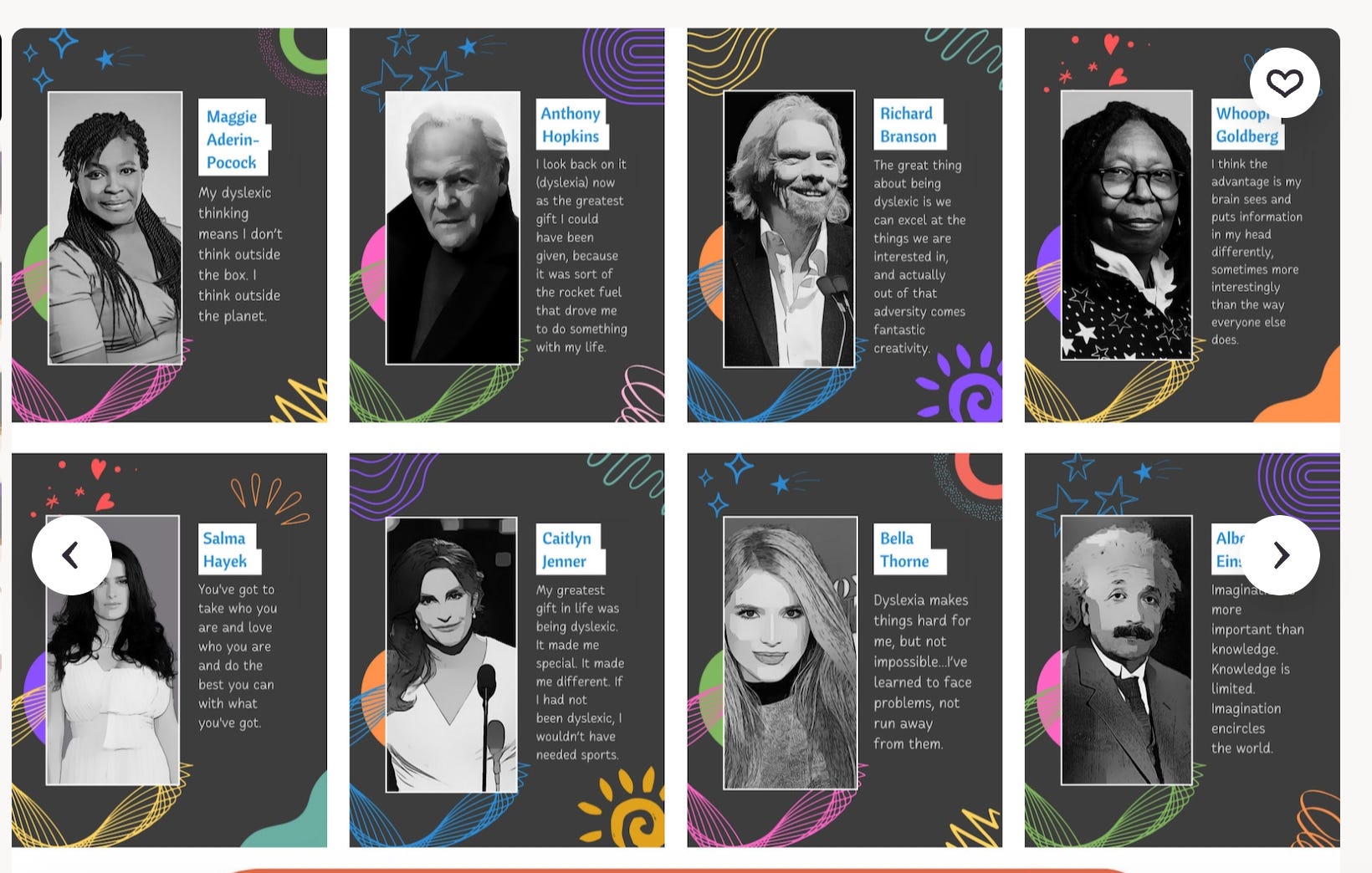
While trying to find the original Zoe Wannamaker poster I found this, for sale on Etsy. I can only imagine how much it’s going to help today’s teenagers to know that Anthony Hopkins and Caitlyn Jenner are dyslexic.
My best hope is that in a world of chronic over diagnosis, where adults like me spraygun their ADHD certificates as proof of something, perhaps it doesn’t actually leave children feeling super strange if they are being assessed for something. And that they’ve got rid of the Zoe Wannamaker posters.
*I also once asked to go to the ‘loo’ and was told it was called ‘the toilet’. This is not relevant to being an over diagnosed child but it’s something I’m still annoyed by given that a) toilet is naff and b) if a four year old need to piss you let them piss, you don’t dick around doing Hyacinth Bucket.
**I was ten, it was four pages long and about a single mother called Megan Rainbow. Jaqueline Wilson would have swiftly won a plagiarism suit.
I could never make the eggobox dinosaur. I'd cover myself in glue and green paint. The teacher told my parents I was 'clumsy', which I absorbed to the extent that I expected to fail at anything practical. I don't know if I was merely clumsy. But your account is a salutory tale about not accepting such comments at face value.
"toilet is naff" 👏👏👏